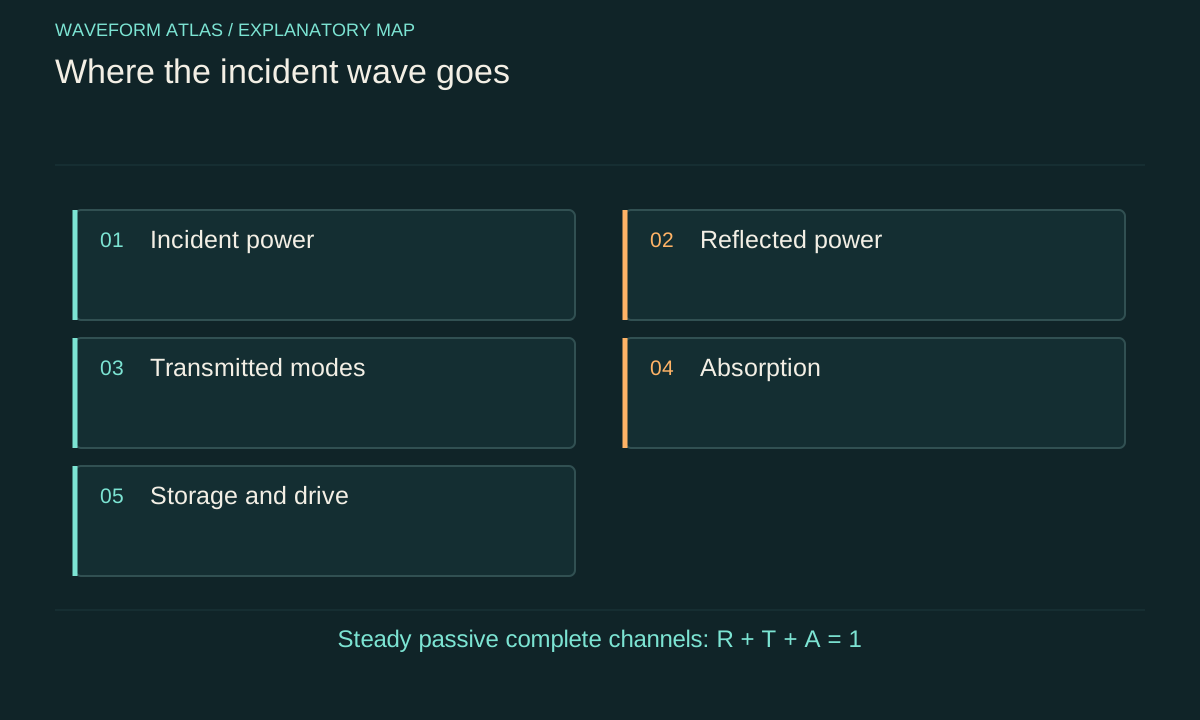
Define the boundary and observation interval
Choose a boundary enclosing the structure and identify every way energy can cross it. For a steady passive two-port experiment, incident, reflected and transmitted powers may dominate, with absorption accounting for energy transferred to material degrees of freedom. A finite-duration experiment also needs the change in stored energy. A driven structure adds work from its controller. The ledger depends on those choices.
State the observation interval and whether the source has reached steady state. A cavity can store energy during turn-on and release it after the input stops. Measuring only the prompt transmitted pulse misses that later output. The same structure can therefore appear strongly absorbing over a short window and nearly lossless over a complete cycle if storage is not included.
Separate the incident and reflected fields
Near a reflecting boundary, a detector often records the sum of incident and reflected fields. Their interference creates nodes and antinodes, so local amplitude does not directly equal either travelling-wave power. A pressure probe or electric-field probe can read a large standing-wave amplitude even when net transmitted flux is small. It can also sit at a node and report almost nothing.
Use directional measurement methods, calibrated spatial sampling or a validated field decomposition to estimate incident and reflected contributions. The source can respond to the returning wave, changing the power it actually delivers. A nominal generator setting is therefore not always a reliable incident-power reference. Measure at a defined plane and account for the intervening cables, guides or acoustic paths.
Power coefficients require flux normalization
Reflection and transmission coefficients can refer to complex field amplitudes or to powers. Those are different quantities. If media or modes have different impedances, a squared amplitude ratio alone does not give the transmitted power fraction. Include the appropriate flux normalization, such as impedance or group-velocity factors for the stated model. Otherwise an amplitude larger than the incident amplitude can be mistaken for gain.
For a simple lossless interface with real positive impedances, the amplitude reflection coefficient is (Z₂−Z₁)/(Z₂+Z₁), while transmitted power fraction is 4Z₁Z₂/(Z₁+Z₂)² under the corresponding travelling-wave conventions. These expressions assume the simple normal-incidence scalar setting. Vector, oblique or multimode problems require their own boundary matching and normalization.
Work through an impedance example
Let Z₂=4Z₁. The amplitude reflection coefficient is 0.6, so reflected power fraction is 0.36. The corresponding transmitted field amplitude can be 1.6 times the incident amplitude under the stated convention, yet transmitted power fraction is 0.64. The total is one. The larger amplitude is compatible with conservation because the energy-flux conversion differs between the two media.
These are calculated interface values, not experimental observations. They illustrate why the measured field variable and impedance must accompany a power claim. In a finite slab, a second interface and multiple reflections change the total response. A single-interface formula cannot be applied independently to each measured output without accounting for the coherent field inside the complete structure.
Absorption is a residual only in a complete model
If all other channels are measured and the system is passive and steady, absorption fraction can be inferred as A=1−R−T. But uncollected scattering or mode conversion can produce the same deficit. A detector with a narrow aperture may miss redirected power. A receiver matched to one polarization may reject another. Those omissions must be included before the residual is assigned to material heating.
A calorimetric or thermal measurement can provide independent evidence of absorption, although heat flow has its own time constants and backgrounds. Compare the inferred optical or acoustic deficit with that measurement over compatible intervals. A mismatch can reveal unmeasured channels or calibration errors. The goal is to close the ledger within uncertainty rather than force the residual into a preferred category.
Side channels can dominate a weak transmission
A rough surface or abrupt junction can scatter into many directions or modes. Some may return toward the source, some travel laterally and others couple into a substrate or support. A two-detector setup can miss much of this output. The geometry should be chosen to collect or bound channels relevant to the claimed suppression mechanism.
For a waveguide, use mode-resolved measurements or a sufficiently complete receiving arrangement. For a free-space beam, vary collection angle and aperture. For sound, consider structural transmission through the mounting as well as the intended fluid path. A barrier that blocks the direct route can still allow an alternate route around it, so shielding and support geometry are part of the experiment.
Stored energy changes the transient balance
A time-resolved balance can be written dU/dt=P_in−P_out−P_abs+P_drive, with definitions and signs stated. Integrating over an interval includes the difference between final and initial stored energy. If that difference is ignored, delayed emission can appear as unexplained excess output or missing input depending on when the measurement ends.
Measure ringdown after the drive stops or estimate stored energy from a validated mode model. A high-quality resonator can retain energy much longer than a short incident pulse. Conversely, a pre-excited structure can emit more energy during a chosen window than it receives in that same window. The preparation history supplies the missing term; it is not evidence that blocking created energy.
A driven structure can exchange frequency and work
Time-dependent boundaries or material properties can convert an incident frequency into sidebands. A receiver tuned only to the original frequency can report strong suppression even when total outgoing power remains substantial. The control source supplies or receives the difference in energy. A passive two-port relation without a drive term is then the wrong model.
Measure the outgoing spectrum and the drive under a consistent boundary definition. If the device contains gain, include pump power and possible stored energy. A formally negative inferred absorption from incomplete R and T measurements may indicate gain, but it can also indicate calibration error or inconsistent normalization. Determine the mechanism through the complete experiment rather than assigning meaning to a residual alone.
Phase information complements the power budget
Power conservation does not establish coherence. A lossless deterministic scatterer can redistribute coherent amplitudes, while a fluctuating device can preserve average power and randomize phase. Measure complex scattering coefficients or interference with a stable reference when phase preservation matters. Their phases can also reveal resonant storage and propagation effects that intensity-only measurements miss.
A unitary scattering matrix applies to a complete set of appropriately normalized lossless channels under the stated conditions. A measured submatrix can appear nonunitary because some channels were excluded. Conversely, fitting a unitary matrix to incomplete data does not prove the environment was irrelevant. State the mode set and calibration, and test whether the same matrix predicts several independent input preparations.
Propagate uncertainty through the residual
Suppose illustrative measurements give R=0.80 with uncertainty 0.02 and T=0.10 with uncertainty 0.01, treated as independent standard uncertainties. The residual is 0.10 with combined standard uncertainty approximately 0.0224 before incident-power calibration and other systematic terms. This calculation shows that a residual needs an uncertainty, not just a decimal obtained by subtraction.
Shared calibration errors can correlate R and T and alter that estimate. Include covariance when appropriate. If the residual is comparable with uncertainty, report a bound or an unresolved deficit rather than a precise absorption fraction. More averaging reduces some statistical noise but cannot remove an uncalibrated collection efficiency. The uncertainty budget should identify the measurement that most limits the physical conclusion.
A useful report gives incident, reflected, transmitted and other measured power fractions, storage or drive terms when relevant, and the remaining uncertainty. It identifies which channels were directly observed and which were inferred. A diagram can make the ledger clear, but its arrows should represent measured or explicitly modelled quantities rather than invented experimental points.
The result may establish nearly total reflection, substantial absorption, coherent mode conversion or a combination. Each explains a dark transmission detector differently. Following the incident wave through those channels turns blocking into a quantitative physical process and prevents a missing output from being mistaken for disappearance of energy, annihilation of particles or automatic quantum-state reduction.
For a coherent two-port device, the phase of the reflected amplitude can matter even when reflected power is fixed. A change from r to −r leaves |r|² unchanged but shifts the standing-wave pattern formed with the incident field. A local probe can then move from a maximum toward a minimum without any change in reflected energy. This calculated observation is another reason to separate directional power measurements from local field height. If the experiment changes frequency or boundary conditions, record the relevant phase or sample enough positions to avoid interpreting a moving node as additional absorption. The complete flux budget remains the reference for conservation.
What to take forward
- Missing transmission can be reflected, scattered, stored or absorbed.
- Amplitude coefficients need flux normalization before becoming powers.
- A residual absorption estimate requires a complete uncertainty budget.
Go to the original work.
These links identify the sources behind specific claims. Verification scope varies by source and is stated below.
- 1 / University teachingHaus and Melcher, Electromagnetic Fields and Energy, Chapter 11: Energy, Power Flow, and Forces ↗
Conservation of field energy including surface flux, stored energy, dissipation and electromechanical exchange.
Verification scope: Official textbook chapter opening and integral energy-conservation section inspected; not a claim of reading all 90 pages.
Found a problem with a claim or calculation? Send the page, the claim and the evidence. Read how these articles were prepared.