Define the travelling channel
A propagation statement needs a wave equation, a frequency range and a mode. In a hollow guide, transverse boundary conditions determine which longitudinal travelling modes exist. In a periodic medium, Bloch modes determine allowed propagation bands. In a quantum barrier, the potential and particle energy determine whether local stationary solutions oscillate or vary exponentially. These examples share mathematical features but represent different physical quantities.
Specify the direction as well. A field can be confined transversely while propagating freely along an interface or guide. Blocking motion in one direction does not mean blocking every direction. The detector's selected polarization, spatial mode and frequency band also define the measured channel. A weak output in that channel may coexist with strong propagation elsewhere in the full system.
A cutoff changes the longitudinal wave number
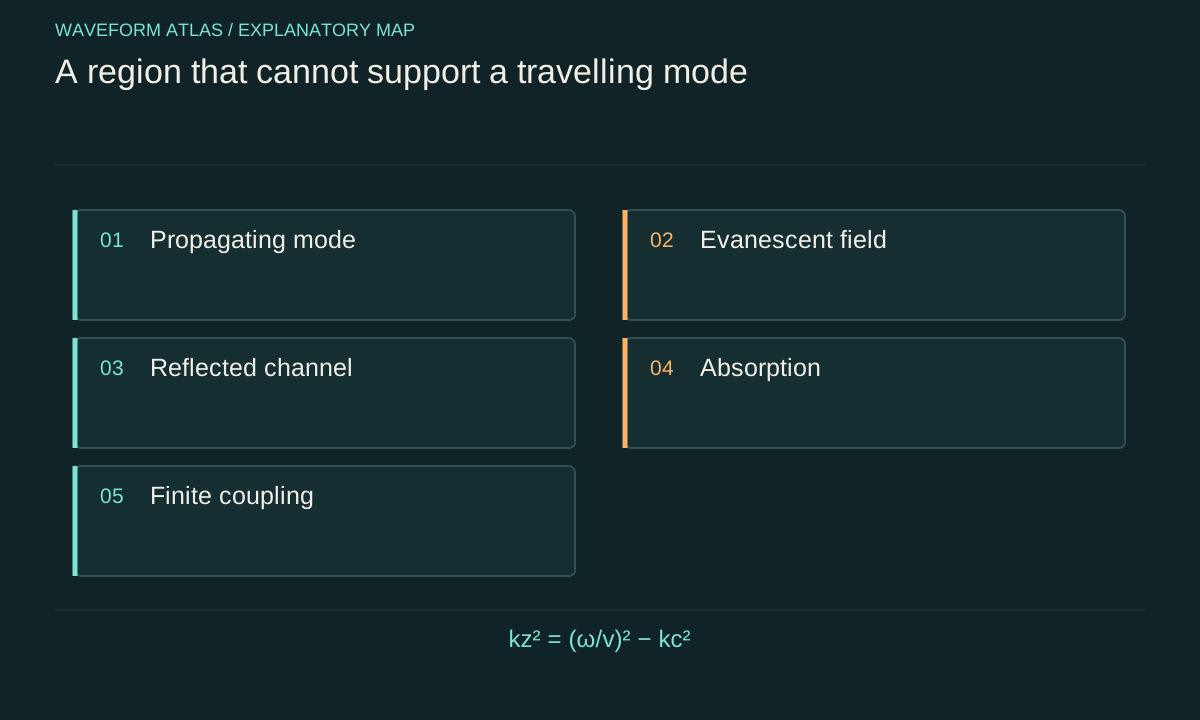
A simple guide dispersion relation has k_z²=(ω/v)²−k_c², where k_c is set by the transverse mode and geometry. Above cutoff, k_z can be real and the mode has an oscillatory longitudinal dependence. Below cutoff, k_z becomes imaginary in the ideal lossless model, producing exponential spatial dependence. The mathematical change concerns mode support, not a command that every field component vanish.
The cutoff frequency is ω_c=vk_c. Near it, propagation and impedance differ strongly from those of an unconstrained plane wave. A real guide also has losses, finite length and coupling transitions, which influence measured transmission. A calculated cutoff is therefore a baseline for interpreting a spectrum, not a complete prediction of the detector response without the rest of the apparatus.
Evanescent fields can remain present
A below-cutoff field can decay with distance into the blocked region while oscillating in time at the drive frequency. A probe placed near the entrance may detect it. This is evanescence: spatial decay under the stated boundary conditions. It differs from temporal damping of a freely evolving excitation. A plot should label distance and time distinctly so that the two mechanisms are not confused.
In an ideal semi-infinite lossless arrangement, a single decaying evanescent component need not carry average power into the forbidden direction. It can still store energy or carry energy parallel to an interface. A finite region coupled to another propagating channel has a different boundary-value solution and can transmit. The field's complete spatial structure and phase determine the flux, not its exponential magnitude alone.
Reflection is a common outcome
If the structure is lossless and no other outgoing channel is available, incident power can return as a reflected wave. A dark transmission detector then indicates reflection rather than energy destruction. The incident and reflected fields can form a standing pattern near the boundary. Local field maxima or nodes may appear even though the net flux through the blocked region is small.
Measure reflected power with an appropriate separation of incident and returning components. A sensor that records their sum can confuse interference with source variation. Include the source impedance and the possibility that reflected energy changes the source's delivered power. The comparison should use actual incident power at the structure, not only a nominal generator setting that may depend on the load.
Absorption requires a dissipative channel
A material can suppress transmission by transferring field energy into microscopic excitations and heat. This is different from a purely geometric cutoff, although both can occur together. A complex material response or effective loss term represents that exchange in a model. The lost signal does not disappear from the complete energy budget; it leaves the measured coherent channel.
Measure or bound reflection, scattering and heating before identifying absorption from transmission alone. A black-looking object in one spectral band can behave differently elsewhere. Likewise, a narrowband receiver can miss frequency-converted output from a driven medium. State the frequency range and collection geometry of the energy account. A single optical or acoustic darkness measurement is not a universal absence test.
Finite barriers can transmit
For a quantum particle with energy below a finite barrier height, the stationary wavefunction inside the barrier contains exponential components. Matching it to propagating waves on both sides generally gives nonzero transmission. The probability depends on barrier height, width and incident energy. The phenomenon does not require a particle to borrow energy temporarily; the complete stationary solution conserves energy for a time-independent real potential.
The same broad distinction appears in classical evanescent coupling: a finite gap can connect two propagating regions. The exact transmission formula depends on the field and boundary conditions, so one should not transplant a quantum rectangular-barrier expression directly into an arbitrary electromagnetic guide. What carries across the analogy is the need to solve the complete finite structure rather than treating local exponential decay as an absolute wall.
Periodicity creates another kind of blocking
A periodic material supports Bloch modes whose dispersion can contain band gaps. Within a specified gap, no bulk propagating mode exists for the relevant direction and polarization in the ideal infinite structure. A finite stack can strongly reflect a corresponding frequency range while retaining evanescent fields and allowing small transmission. Defects can introduce localized or guided states inside a bulk gap.
A gap in one direction is not automatically a complete gap for every direction and polarization. State the band calculation and the measured incidence conditions. Disorder, finite size and absorption can modify the spectrum. A transmission dip alone can also arise from a resonance or poor coupling, so a claim of band-gap blocking needs a model and controls that identify the periodic mechanism.
Confinement can preserve an excitation
A bound quantum state or ideal cavity mode can remain localized while retaining energy. Its inability to propagate away is a property of confinement, not proof of destruction. A stationary bound-state density can have exponentially decaying tails outside the central region. Those tails do not imply steady leakage if the energy lies below the available external continuum and the Hamiltonian is time independent.
Real cavities often have finite leakage and absorption, producing ringdown. Measure that decay separately from the spatial confinement profile. A guided mode can also be bound in one transverse direction while carrying energy longitudinally. Specify which coordinate is confined and which observable evolves in time. These distinctions prevent the everyday phrase blocked wave from erasing the physically important category of stored or guided excitation.
A changing barrier exchanges work
If a barrier or medium changes while a wave is present, the control introduces time dependence. Energy need not remain constant in the field subsystem, because the drive can supply or receive work. Frequency conversion, reflection and excitation can occur. The final barrier height alone does not determine the output; the switching history and the initial field matter.
Measure the control waveform and outgoing spectrum, including sidebands outside the original detector band. A rapid switch can make the original-frequency transmission dark while sending energy into other frequencies or stored modes. Use a time-dependent model for that process rather than a static transmission coefficient evaluated only at the final setting. The controller is part of the physical account.
A dark detector has several alternatives
Reduced transmission can result from a weak source, misalignment, detector saturation elsewhere in the chain, insufficient bandwidth, mode mismatch, reflection, absorption or genuine cutoff. The first step is to establish that the source and receiver remain calibrated across the sweep. A reference path or incident-power monitor helps separate a propagation effect from changing excitation.
Then measure complementary channels and vary a parameter that separates the candidate mechanisms. Length dependence can test evanescent attenuation; reflection can identify a lossless stop region; temperature or heating can support absorption; mode-resolved detection can reveal conversion. The goal is not merely to repeat a null, but to make competing explanations predict different observable changes.
A strong result identifies a mode, frequency interval, geometry and measured transmission bound, together with reflection or other-channel accounting. It may establish that an idealized mode is below cutoff, that a finite structure strongly suppresses transmission, or that a dissipative material absorbs the incident wave. Each is useful without implying elimination of every field or quantum state.
If the claim concerns quantum outcome selection, add a phase-sensitive state test and a model that predicts more than ordinary scattering. Blocking a path changes available amplitudes; it does not by itself establish a universal collapse law. Following the full field and its energy makes the blocked region a tractable boundary-value problem rather than a place where physics is assumed to stop.
A hypothetical three-channel measurement illustrates the distinction. Suppose a normalized incident power of one produces 0.02 in the forward channel, 0.93 in reflection and 0.05 in measured absorption. The forward wave is strongly suppressed, yet the complete energy account closes. If the reflected detector were omitted, the same experiment would leave 98 percent of the input unexplained by the forward reading alone. These numbers are illustrative bookkeeping, not experimental points. A different device could give the same forward fraction with a very different reflected and absorbed distribution. The extra channels therefore identify the mechanism in a way that transmission alone cannot.
What to take forward
- Blocked propagation is defined for a particular mode and direction.
- Evanescence, reflection and absorption leave different observables.
- A complete channel account is needed beyond a dark receiver.
Go to the original work.
These links identify the sources behind specific claims. Verification scope varies by source and is stated below.
- 1 / University teachingMIT 6.013 (Spring 2009), L16: TEₘₙ rectangular waveguide, cavity resonators, perturbations ↗
D. Staelin, MIT 6.013 Electromagnetics and Applications, Lecture 16: TEₘₙ rectangular waveguide, cavity resonators, perturbations (Spring 2009).
TE/TM rectangular-guide dispersion and geometric cutoff under ideal assumptions.
Verification scope: Official course index title and current download URL verified; PDF slides 3–6 read for dispersion, evanescence, mode restrictions and cavity frequencies.
- 2 / University teachingOpenStax, Quantum tunneling through potential barriers ↗
Finite rectangular-barrier scattering and exponential sensitivity to barrier width.
Verification scope: Textbook equations and barrier example inspected; bound-state distinctions independently stated in the article.
- 3 / University teachingSteven G. Johnson, MIT Mathematical Methods in Nanophotonics: Lecture Summaries ↗
Bloch modes, one-dimensional photonic band gaps, evanescent modes, defects and guided-mode distinctions.
Verification scope: Official author course summaries inspected; not a claim that the entire linked textbook was read.
Found a problem with a claim or calculation? Send the page, the claim and the evidence. Read how these articles were prepared.