Combine two coherent inputs
Adjust the controls, inspect the calculated response and use the reading links to place the model in its physical context.
Interactive model: Combine two coherent inputs. Enable JavaScript to adjust its controls.
P₊ = [1 + r² + 2r cos φ] / [2(1 + r²)]
Ideal lossless balanced combiner with a chosen phase convention. Curves show input field amplitudes and their sum; the readouts give normalized power fractions in the two output ports.
What this model assumes
Ideal lossless balanced combiner with a chosen phase convention. Curves show input field amplitudes and their sum; the readouts give normalized power fractions in the two output ports.
How to explore it
Begin with the default values. Change one control at a time and watch both the graph and the readouts. Then reset the model and change another parameter. This isolates which input produces the effect you are seeing.
The plotted values are generated from the displayed equation. Downloading the calculated data lets you inspect the numerical series or compare it with a calculation of your own. The data are synthetic model outputs, not observations from an apparatus.
Before carrying a prediction into an experiment, match the model’s assumptions to the actual system: the relevant degrees of freedom, boundary conditions, noise, losses and measurement convention. The linked articles explain which comparison is physically meaningful.
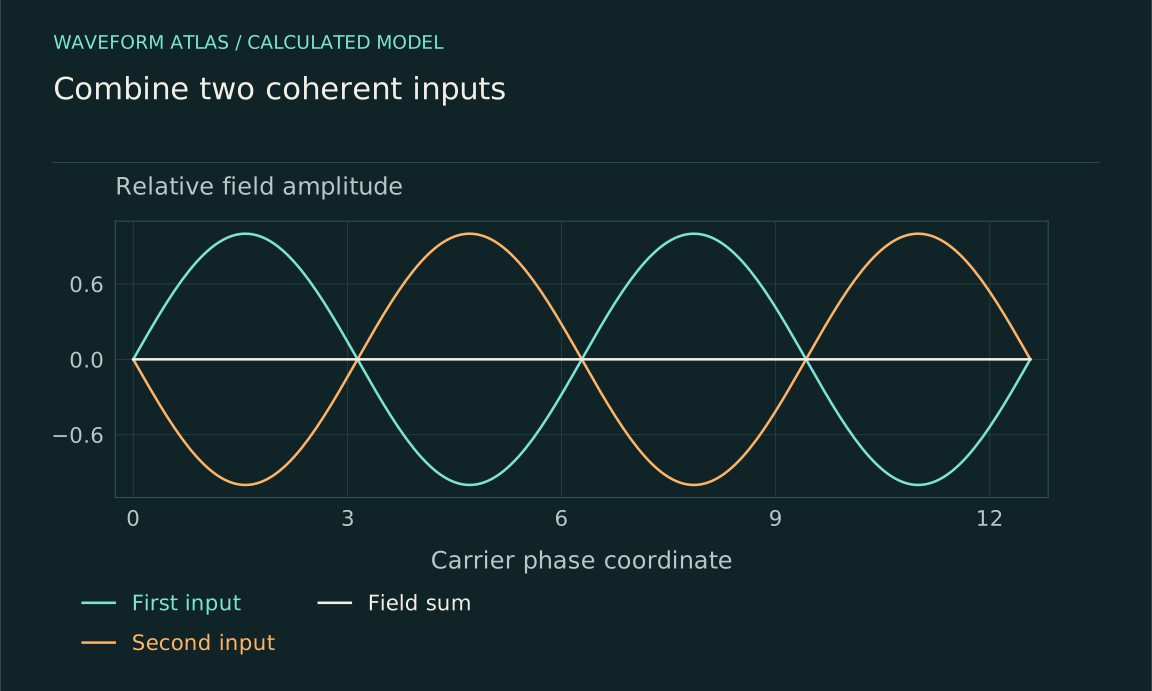
Calculated model curves. Ideal lossless balanced combiner with a chosen phase convention. Curves show input field amplitudes and their sum; the readouts give normalized power fractions in the two output ports. Default control values are used in this fixed figure.
Download SVG ↓Destructive interference
When waves cancel at a location
What conditions produce destructive interference?
Opposite phase is only one requirement
Why can two nominally opposite waves fail to cancel?
Where the energy goes when a detector goes dark
How can one output lose intensity while total energy remains accounted for?
What active noise cancellation actually cancels
Why is cancellation limited by position, frequency, and delay?
A dark output is not a vanished quantum state
How does a beam splitter direct amplitudes into different outputs?
Zero displacement at a node
What can still exist around a stationary-wave node?
Why a single phase setting does not cancel every frequency
How do bandwidth and path delays limit destructive interference?
Interference combined with absorption
How is coherent perfect absorption different from cancellation in a lossless system?
Build a phase-controlled interference demonstration
What measurements show genuine cancellation rather than a failed source?
Why interference cancellation does not solve the measurement problem
Which mathematical step is absent from a lossless interference experiment?