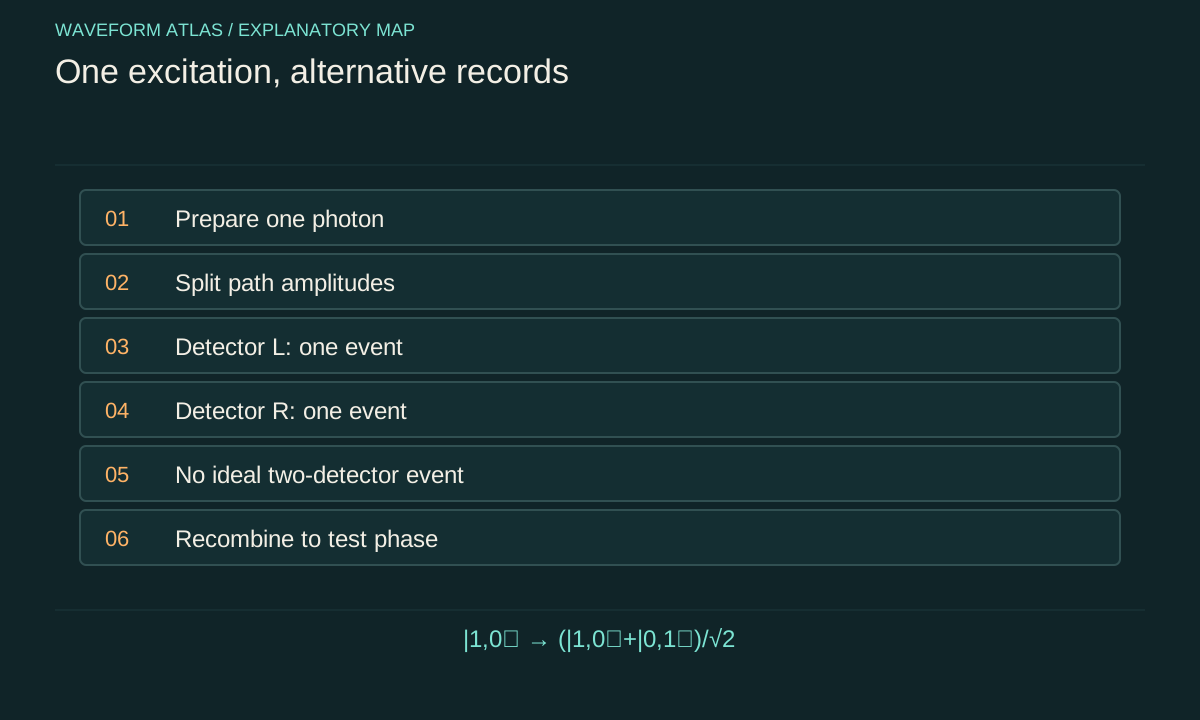
Specify a one-photon input state
The ideal preparation contains one photon in a defined optical mode and vacuum in the other splitter input. A balanced lossless transformation gives (|1,0〉 + |0,1〉)/√2 under a chosen phase convention. The two entries count photons in the two output modes.
The state contains no |1,1〉 component, which would mean two photons, and no two half-energy components. Its total photon-number operator has value one. The amplitudes describe alternative mode occupations within one quantum state, not a pair of smaller photons.
A real source may only approximate this preparation. It can include vacuum trials, multiphoton events or imperfect temporal and spectral modes. Those features must be measured rather than inferred from a weak average intensity. The ideal state is a model to test against calibrated statistics. Calling a source dim is not enough to establish that every occupied trial contains exactly one photon or that the output has the coherence assumed in the formula.
Probability division differs from energy division
For a photon of frequency ν, an ideal complete absorption transfers energy hν. A balanced splitter gives each output a one-half detection probability, but it does not reduce the photon frequency to ν/2 in each path. The energy associated with an individual successful absorption remains hν under the ideal frequency-preserving model.
The expectation value of energy in either output is hν/2. This average arises because half the ideal trials deposit hν there and half deposit zero. It should not be confused with every trial depositing a half-sized packet. The distinction is between a distribution of outcomes and one fractional outcome.
For an illustrative wavelength of 600 nm, hν is about 3.31 × 10⁻¹⁹ joule, or 2.07 eV. Each ideal detector event corresponds to that photon energy, subject to the detector’s absorption process. The balanced ensemble average per output is half that value. Writing both numbers makes the statistical meaning of splitting explicit without contradicting energy quantization.
The energy variance of either ideal output is then (hν)²/4, another measurable distinction from a deterministic half-energy deposit.
Direct detections are anticorrelated in the ideal case
With perfect direct detectors on both outputs and exactly one input photon, each trial produces a click on one side or the other, never both. The joint probability of two ideal detections from that one excitation is zero. This is the simplest anticorrelation prediction.
Detector inefficiency introduces no-click trials. For splitter transmission T and detector efficiencies ηL and ηR, the single-click probabilities are TηL and (1 − T)ηR in a simple model without backgrounds. Their sum can be less than one, while the ideal two-click probability remains zero.
A missing click therefore does not imply the photon was divided into pieces too small to detect. It may have been lost, missed or outside the detection window. Conversely, observed coincidences can arise from multiphoton input, dark counts or unrelated light. The comparison requires a complete source-and-detector model. The ideal anticorrelation is a clear prediction, but the raw data need corrections and uncertainty estimates before they can establish how closely a real preparation approaches it.
A weak coherent pulse is a different preparation
An attenuated coherent pulse has a photon-number distribution, including vacuum and a small multiphoton probability. Splitting it produces coherent outputs whose ideal counts are not the same as those of a guaranteed one-photon state. Very low intensity can make coincidences rare without making their normalized statistics single-photon-like.
For a concrete ideal example, take a coherent pulse with mean photon number 0.1 and a balanced splitter. Each output has mean 0.05. With perfect threshold detectors, each click probability is 1 − exp(−0.05), about 0.0488. The coincidence probability is their product, about 0.00238.
Those small numbers are ordinary consequences of a weak coherent input, not evidence of an exactly one-photon source. One must normalize coincidence information appropriately and account for the preparation protocol. The example also shows why collecting too few trials can be misleading: zero observed coincidences in a small sample may be compatible with a nonzero expected probability. Statistical sensitivity belongs in the interpretation.
Historical evidence combines complementary tests
Grangier, Roger and Aspect’s 1986 experiment investigated photon anticorrelation at a beam splitter using a triggered source and also examined interference. The inspected original-paper abstract supports this combination of tests. It is cited here for the experimental distinction, without reproducing uninspected numerical details or claiming that our illustrative detector model is their exact apparatus.
Anticorrelation and interference address different questions. The first tests the detection statistics associated with a single excitation. The second tests coherent amplitude relations between alternatives. A preparation can have path populations that look correct while lacking the phase relation needed for interference.
This is why the phrase wave-particle behavior should not replace the actual observables. The evidence consists of count correlations and phase-dependent probabilities under specified preparations. Describing both lets the reader understand what the experiment rules out and what it does not. A dramatic cartoon of one photon choosing or dividing its route cannot substitute for those measured statistical relationships.
Path counts alone cannot distinguish a superposition from a mixture
The coherent state (|L〉 + |R〉)/√2 and an equal statistical mixture of |L〉 and |R〉 give the same fifty-fifty direct path probabilities. If detectors are placed immediately after the splitter, those populations do not reveal the off-diagonal coherence.
Recombining the paths changes the measurement basis. For the coherent state, a controlled relative phase produces sinusoidal output probabilities. For the equal mixture, an ideal phase scan leaves balanced outputs because there is no stable cross term to modulate.
The distinction is operational. It does not require assigning a classical trajectory to each undetected photon. It requires comparing predictions for different measurements on the prepared state. A useful experiment first calibrates path populations and then tests recombination. Reporting only one of those observations leaves an important ambiguity. Single-photon character concerns excitation statistics; path coherence concerns relationships between amplitudes. They can be studied together, but neither is automatically established by the other.
Timing windows and accidentals affect the record
Real coincidence measurements define a time window within which detector events count as belonging to the same trial. A wider window accepts more true timing variation but also more unrelated events. A narrower window can reject genuine events if jitter or path delay is not accounted for.
Background estimates should use a protocol that captures the relevant accidental rate. Delayed windows or independent source-off measurements can help, depending on the apparatus. The method must preserve the same detector conditions and analysis thresholds used for the signal.
Detector dead time, afterpulsing and unequal efficiencies can also distort correlations. These are not reasons to abandon the measurement; they are parts of its response model. A reliable result reports raw counts, normalization, background treatment and uncertainty. Without that information, a low coincidence number may reflect the source, the detectors or the chosen window. The physical conclusion should emerge from the calibrated statistics rather than from the visual scarcity of simultaneous clicks.
A path marker changes coherence through correlations
If the photon’s path becomes correlated with distinguishable marker states, the joint state can be written (|L〉|mL〉 + |R〉|mR〉)/√2. Interference in the unconditioned path measurement is weighted by the marker overlap 〈mR|mL〉.
Orthogonal marker states can remove the path interference even if no person reads the marker. The relevant physical fact is the correlation and available distinguishability, not human awareness. If the marker states remain partially overlapping, partial interference can remain.
This does not mean the photon energy was split into independent pieces. The one-excitation state now includes another degree of freedom. A conditional marker measurement can reveal different subensembles, but any claimed recovery must state the conditioning and retained event fraction. The full record remains consistent with quantum probabilities. Path splitting, path marking and final detection are separate operations, and their order determines which statistical questions the experiment can answer.
Interpret each record at the level it supports
A direct click establishes an absorption record in a detector under its response model. A distribution of clicks estimates path probabilities. Suppressed coincidences constrain multiphoton or classical alternatives under stated assumptions. A phase-dependent recombination pattern establishes coherence in the tested modes.
These statements fit together without a literal half-photon picture. The splitter acts on amplitudes; the prepared state determines counting statistics; the detector produces localized records. Loss and background add practical outcomes that must be modeled rather than treated as exceptions to the ideal story.
The strongest report therefore separates preparation quality, splitter calibration, detector performance and coherence tests. It states what was measured and which idealizations remain. A single photon can be coherently distributed across paths while each ideal detection carries a whole photon’s energy. That is a precise quantum statement about state and measurement, not a claim that ordinary optical hardware fragments the photon into smaller particles.
What to take forward
- Half a path probability is not half a photon’s detected energy.
- Weak coherent light and a single-photon state have different normalized counting statistics.
- Anticorrelation tests excitation statistics; recombination tests path coherence.
Go to the original work.
These links identify the sources behind specific claims. Verification scope varies by source and is stated below.
- 1 / University teachingChapter 2: Experiments with photons ↗
Barton Zwiebach (2016). Chapter 2: Experiments with photons. MIT 8.04 Quantum Physics I, lecture notes, 9 February 2016, pp. 1–8.
Normalized two-port amplitudes, beam-splitter phase conventions and Mach–Zehnder interference.
Verification scope: Official MIT Chapter 2 PDF inspected for the two-port convention and interferometer calculation; independently derived examples are identified in the articles.
- 2 / Primary experimentExperimental Evidence for a Photon Anticorrelation Effect on a Beam Splitter: A New Light on Single-Photon Interferences ↗
P. Grangier; G. Roger; A. Aspect. Europhysics Letters 1(4), 173–179 (1986).
DOI: 10.1209/0295-5075/1/4/004
Triggered antibunching/anticorrelation at a splitter and interference in the same experimental program.
Verification scope: Publisher record and original-paper abstract inspected; the original paper’s Mach–Zehnder passage was checked for the geometry distinction. No complete experimental reanalysis is claimed.
- 3 / Primary theoryFringe Visibility and Which-Way Information: An Inequality ↗
Berthold-Georg Englert. Physical Review Letters 77(11), 2154–2157 (1996).
DOI: 10.1103/PhysRevLett.77.2154
A quantitative complementarity relation between two-path fringe visibility and available which-way information.
Verification scope: APS publisher abstract and NLM bibliographic record inspected. The source supports the defined visibility–which-way inequality; numerical marker examples in this article are independent calculations.
Found a problem with a claim or calculation? Send the page, the claim and the evidence. Read how these articles were prepared.