Define loss relative to a measurement boundary
A splitter may direct less than the full incident power into its two nominal outputs. The missing fraction can be absorbed in the element, scattered into other directions or coupled into modes the apparatus does not collect. Calling all of it absorption is an inference that needs evidence.
The system boundary determines the word loss. Light leaving a collection aperture is lost to that measurement but still exists elsewhere. Energy absorbed in a coating transfers to material degrees of freedom. A detector that fails to register an arriving photon introduces another inefficiency after the optical transformation.
A clear diagram labels these stages separately. It distinguishes incident flux, physical output flux, collected flux and recorded events. This prevents a detector count deficit from being assigned entirely to the splitter. It also makes conservation testable: the complete input must equal outputs, stored changes and transfers across the chosen boundary, within uncertainty. A reduced two-port model can be useful, but its missing channels should remain explicit rather than treated as mysterious disappearance.
Use absolute fractions before renormalizing
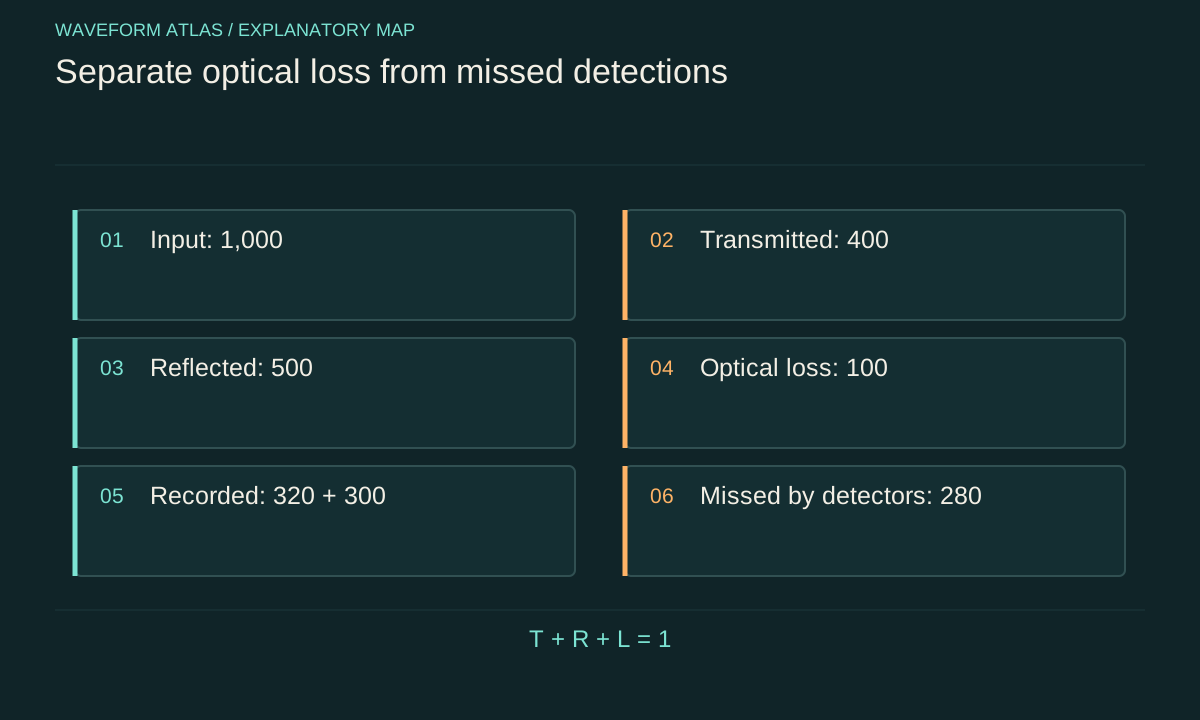
For one input, let T and R be physical fractions reaching the two defined output modes, and L the fraction elsewhere. In a passive stationary model with no other energy source, T + R + L = 1. The relation assumes consistent frequency and flux normalization.
Suppose T = 0.4, R = 0.5 and L = 0.1. Among surviving photons in the two outputs, the normalized proportions are 4/9 and 5/9. Those conditional numbers sum to one, but they conceal the ten-percent optical loss if reported without the survival fraction.
Both descriptions are legitimate when labeled. Absolute fractions answer how much of the input reaches each channel. Conditional fractions answer where a detected or surviving subset is distributed. Confusing them can make a lossy device appear lossless or make a changed detector efficiency look like a changed splitting ratio. The denominator is part of the physical claim, not a minor presentation choice added after the analysis.
A count budget separates two sources of missing records
Take an illustrative input of 1,000 single-photon trials with the preceding optical fractions. Four hundred photons reach the transmitted mode and five hundred the reflected mode. Let the detectors have efficiencies 0.8 and 0.6. Expected recorded counts are then 320 and 300.
The apparatus records 620 events, leaving 380 trials without a recorded event. Only 100 of those correspond to the assumed optical loss. The remaining 280 are photons reaching the two outputs but missed by the detectors. A raw no-click fraction of 38 percent would therefore badly overestimate the splitter’s ten-percent loss.
Correcting the two channels independently recovers 400 and 500 expected output photons. The calculation assumes known efficiencies, negligible dark counts and no ambiguity in the trial definition. Real uncertainties must be propagated, and correlations between calibrations can matter. The example demonstrates why a complete measurement chain is necessary before interpreting a count deficit as a property of the optical element itself.
This ledger assumes independent preparation trials and independent detector responses under the stated simplified measurement model.
A larger quantum description restores the missing channels
A reduced two-output amplitude map can be nonunitary because it omits environmental modes. The larger optical-plus-environment evolution can still preserve total probability. For a simple one-photon input, a schematic state has amplitudes √T for transmission, √R for reflection and √L for an environmental excitation.
The environmental label may represent scattered light or an excitation associated with absorption; it should not be interpreted as the same physical channel in every material. The model’s purpose is to keep the alternatives and normalization explicit. The full probabilities sum to one even though the observed optical subset does not.
Tracing over the environment can produce a reduced optical state containing both surviving one-photon components and a vacuum component. Conditioning on survival removes the vacuum trials from that description. This is an analysis operation on a selected ensemble, not a physical recovery of lost energy. A clear account states when such conditioning occurs and how the success probability is measured.
Attenuation and decoherence are different changes
Loss reduces the probability or power remaining in selected modes. Decoherence reduces interference between alternatives in a reduced state. The two can occur together, but one does not uniquely determine the other.
A simple coherent attenuator can reduce one path’s amplitude while preserving the relative phase of the surviving components. Their later fringe may have reduced visibility because of imbalance, even without additional phase randomization. Conversely, random phase noise can wash out a fringe while leaving total throughput nearly unchanged.
The appropriate characterization therefore measures absolute transmission and interference contrast separately. A high-loss device can retain excellent conditional coherence, while a high-throughput device can have poor phase stability. Reporting one number as overall quantum quality hides this distinction. A useful model identifies which term changes: amplitude magnitude, relative phase distribution, mode overlap or environmental distinguishability. Each leads to different controls and different strategies for improving the apparatus.
Uncollected scattering can mimic absorption
If a detector samples only a narrow outgoing beam, roughness or misalignment can send power outside its acceptance. The measured deficit then reflects redistribution in angle or spatial mode. A thermal measurement of the element might show much less deposited energy than the apparent optical loss suggests.
Expanding the collection aperture or measuring the angular distribution can test this explanation. An integrating measurement can estimate total transmitted and reflected power, while imaging reveals where it goes. The methods answer complementary questions and require their own calibration.
Absorption claims should connect missing optical energy to material heating or another justified microscopic response. Even then, transient storage and thermal transport can delay the signal. A steady-state balance and a pulsed balance need different terms. The point is not that absorption is unusual; it is that a two-detector deficit alone does not identify it. The receiving channel must be measured or modeled before the word loss becomes a mechanism rather than a description of incomplete collection.
Wavelength and polarization dependence can matter
A real splitter’s transmission, reflection and phase response can depend on wavelength, polarization and incidence angle. A broad input therefore samples a distribution of transformations. Averaging that distribution can change both throughput and observed interference.
For example, two spectral components may each transmit efficiently but acquire different relative phases. A detector that integrates them can record reduced fringe contrast even when neither component individually loses coherence. Similarly, different polarization responses can create path-dependent distinguishability.
A useful calibration measures the device under the same input conditions as the experiment or uses a justified spectral and polarization model. A single manufacturer-style ratio at one wavelength cannot automatically characterize a broadband pulse. The complete prediction integrates the source distribution, device response and detector sensitivity. This makes it possible to distinguish actual absorption from dephasing caused by unresolved frequency or polarization dependence, and to identify which additional measurement would resolve an ambiguous loss estimate.
Background and normalization can distort inferred efficiency
Background counts add to the observed outputs while detector inefficiency removes events. If background is not subtracted consistently, a highly lossy channel can appear more efficient than it is. At low signal levels, the background uncertainty may dominate the inferred transmission.
Input normalization matters too. A fluctuating source measured in a separate time interval can produce an apparent gain or loss unrelated to the splitter. A reference monitor, interleaved measurements or a calibrated trial trigger can help establish the incident flux during the actual acquisition.
The analysis should retain raw counts, background estimates, efficiency corrections and exposure times. Uncertainty should be propagated through the ratios rather than attached only to the final rounded number. A negative inferred loss or a fraction slightly above one may indicate ordinary calibration uncertainty, but a significant discrepancy requires investigation. Conservation is a diagnostic constraint that can reveal mismatched boundaries or normalization errors before they are promoted into a new physical effect.
Report throughput and conditional behavior together
A complete lossy-splitter result gives absolute T and R, a measured or bounded missing fraction and the detector corrections used. If coherence is tested, it reports the phase scan and mode conditions. If results are conditioned on survival or heralding, it states the selection rule and success probability.
This paired reporting prevents a high-contrast surviving subset from being mistaken for lossless operation. It also avoids dismissing useful coherence merely because the apparatus has low throughput. The practical value depends on the application, but the physics should remain transparent.
The central lesson is that a missing output is a channel-accounting question. It may reflect absorption, scattering, unobserved modes or missed detection. Each has different evidence and different consequences for reversibility. Expanding the model to include those channels preserves a consistent energy and probability ledger while keeping ordinary path splitting distinct from particle breakup or unexplained disappearance.
What to take forward
- Separate splitter loss, collection loss and detector inefficiency.
- Report absolute survival before normalizing the surviving outputs.
- Measure throughput and coherence independently; neither determines the other.
Go to the original work.
These links identify the sources behind specific claims. Verification scope varies by source and is stated below.
- 1 / University teachingChapter 2: Experiments with photons ↗
Barton Zwiebach (2016). Chapter 2: Experiments with photons. MIT 8.04 Quantum Physics I, lecture notes, 9 February 2016, pp. 1–8.
Normalized two-port amplitudes, beam-splitter phase conventions and Mach–Zehnder interference.
Verification scope: Official MIT Chapter 2 PDF inspected for the two-port convention and interferometer calculation; independently derived examples are identified in the articles.
- 2 / Primary theoryFringe Visibility and Which-Way Information: An Inequality ↗
Berthold-Georg Englert. Physical Review Letters 77(11), 2154–2157 (1996).
DOI: 10.1103/PhysRevLett.77.2154
A quantitative complementarity relation between two-path fringe visibility and available which-way information.
Verification scope: APS publisher abstract and NLM bibliographic record inspected. The source supports the defined visibility–which-way inequality; numerical marker examples in this article are independent calculations.
- 3 / Primary theoryQuantum optics of lossy beam splitters ↗
S. M. Barnett, J. Jeffers, A. Gatti, and R. Loudon. Physical Review A 57(3), 2134–2145 (1998).
Quantum input-output theory including linear absorption, added noise and the distinction between loss and retained coherence.
Verification scope: University of Strathclyde author record and abstract inspected, with APS citation metadata. Full text was not retrievable; the article’s normalized one-excitation loss-channel illustration is an independent schematic model.
Found a problem with a claim or calculation? Send the page, the claim and the evidence. Read how these articles were prepared.