One excitation can move between systems
An idealized atom has a ground state and an excited state separated by an energy matching the incoming photon. In a simplified closed single-mode description, the joint state with one photon and a ground-state atom can exchange excitation with the state containing no photon in that mode and an excited atom. This is a statement about the combined system, not the disappearance of all physical activity.
The approximation is most useful when the relevant modes and transition are controlled. A free-space photon has a spatial and temporal mode, and an actual atom can radiate into many outgoing modes. A solid-state detector contains many additional degrees of freedom. Those details determine the probability and reversibility of transfer. The phrase single-photon absorption therefore names a physical interaction that needs an apparatus-specific model; it does not mean every photon reaching an atom is absorbed with certainty.
Energy matching is necessary but not sufficient
The relation E = hν connects a photon's frequency to its energy. A transition can respond strongly when the incident spectral content overlaps its resonance, allowing for linewidth, recoil and the full receiving system. Selection rules and polarization determine which transitions can couple. Spatial overlap and the strength of the interaction also matter.
For an illustrative wavelength of 500 nm in vacuum, hc/λ is approximately 3.97 × 10⁻¹⁹ J, or 2.48 eV. That calculation specifies the incident photon energy; it does not identify an absorber or guarantee a useful electrical output. An atom with a different allowed transition will not simply accept any photon whose energy seems nearby on a rough scale. In a material, bands, phonons and other processes can broaden the available channels. The receiving system's spectrum and coupling matrix elements complete the energy argument.
Spatial mode matching determines access to the transition
An atomic transition has an angular and polarization structure. Light concentrated into the appropriate incoming spatial mode interacts more effectively than light that mostly passes through unrelated modes. A small focal spot alone is not a complete description: the electric-field direction, solid-angle coverage and overlap with the relevant dipole pattern also enter.
Cavities and waveguides can change the accessible mode structure and increase the fraction of emission or absorption associated with a selected channel. This is one reason geometry matters in light–matter interfaces. It controls coupling and boundary conditions without establishing a new collapse law. When comparing two devices, report whether efficiency refers to photons launched into a fiber, photons entering a waveguide, photons arriving near the emitter or photons actually transferred to the desired internal state. Those reference planes can differ substantially.
The temporal envelope is part of the photon mode
A photon wavepacket has a temporal shape that determines how its amplitude arrives at the receiver. For an idealized emitter with specified coupling, time-reversal reasoning relates efficient excitation to the reversed temporal pattern of emission. The familiar exponentially decaying emitted envelope suggests a rising incoming envelope under the corresponding ideal conditions.
A primary experiment with a trapped atom compared rising and decaying single-photon profiles and observed a change in peak excitation, while the overall scattering probability was unchanged within its uncertainty. That distinction is useful: maximizing excitation at a chosen instant and maximizing total interaction probability are different objectives. The result supports control of a specific light–matter process, not universal deterministic absorption. A pulse-shaping claim should identify its objective, timing reference, spectral bandwidth and the competing channels present in the actual receiver.
Absorption can be followed by re-emission
An excited atom can later emit a photon. If the experiment observes only the original forward mode, this later emission can appear as loss from that channel. Depending on the apparatus, some emitted light may return to a useful optical mode, some may leave in other directions and some energy may enter nonradiative material processes.
A temporary excitation is therefore not identical to permanent storage. A quantum memory must transfer the excitation into a state with a useful lifetime and demonstrate a controlled readout. A photodetector instead aims to convert the event into a robust macroscopic record. These devices can begin with related absorption physics while having different success criteria. An energy-and-timing diagram should show the intermediate excitation, all relevant relaxation channels and the interval during which storage or detection is claimed. Otherwise a short-lived transfer can be mistaken for a durable captured photon.
A detector click is an amplified record
Many detectors turn a microscopic excitation into a larger electrical or thermal response. The amplification supplies the energy needed for a readable signal. A large output pulse is not the energy of the incident photon simply enlarged without a source; the detector's bias or stored energy participates. The photon's role can be to trigger a controlled change.
Detection efficiency is the probability that the specified incoming photon produces an accepted record. Dark counts, afterpulses, dead time and threshold choices affect how records are interpreted. A click can occur without a photon, and a photon can arrive without a click. These facts motivate calibration and statistical inference rather than a one-to-one assumption in every raw trace. The physical absorption stage and the instrument's decision to register an event should be described separately, especially when using detected counts to infer an incident state.
Single-photon preparation must be characterized
Calling an optical pulse a single photon is a statement about its quantum state, not merely about low average power. A weak coherent pulse has a distribution of photon numbers: reducing its average energy makes vacuum events common but does not eliminate its multiphoton component. Heralded and deterministic sources have their own efficiency and background limitations.
An absorption experiment should state how the source was prepared and characterized. Coincidence measurements, photon-number statistics or heralding conditions can help establish the relevant input. Postselection also changes the population of trials being analyzed. A reported excitation probability per herald is not automatically the same as a probability per photon arriving at the absorber. Keeping those denominators explicit allows a reader to connect source performance, delivery loss and receiver performance without accidentally multiplying or omitting an efficiency factor.
A simple probability ledger prevents overclaiming
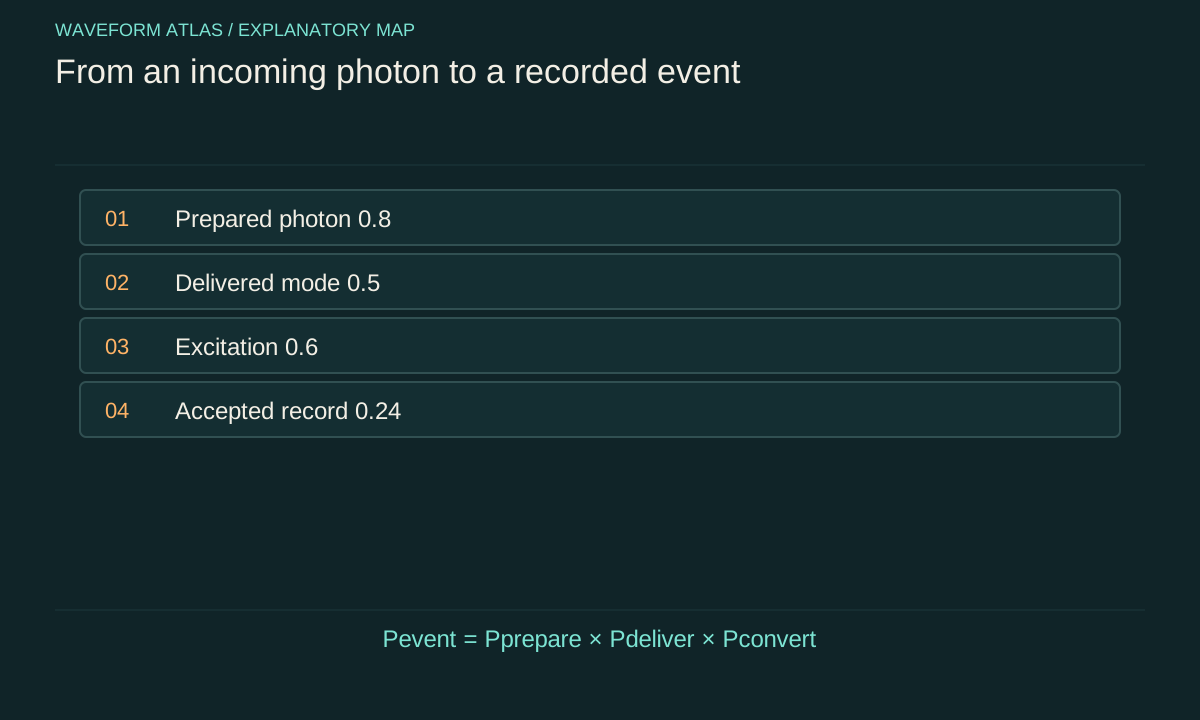
Suppose an illustrative setup prepares an intended photon in 80% of triggered trials, transports 50% of those photons into the receiver mode and converts 60% of the arriving photons into an accepted excitation. The accepted probability per trigger is 0.8 × 0.5 × 0.6 = 0.24, or 24%, before any additional readout loss. These are chosen numbers for accounting, not performance claims for a particular device.
Each factor answers a different engineering question. Improving transport does not change the receiver's intrinsic conversion probability, although it raises the end-to-end rate. A conditional analysis that discards known delivery failures can legitimately report a higher receiver efficiency if it clearly states the conditioning. The danger is using the conditional number as though it describes every original trial. A complete experiment reports the reference plane, accepted events, rejected events and uncertainty associated with each important stage.
Coherence needs an interference or state test
Energy transfer alone does not establish that a photonic qubit survives in the receiver. If information is encoded in a relative phase, polarization or time bin, the receiving process must preserve or predictably transform that relationship. A population measurement can show that an excitation arrived while missing an uncontrolled phase change.
A suitable test prepares several input states and measures complementary output observables, or uses interference and correlations that constrain the desired coherence. Loss and postselection must be included in the interpretation. A high fidelity among successfully retrieved events can coexist with a low total success probability. Both numbers matter, because one describes the quality of accepted transfers and the other their frequency. The experiment's claim should match the measurement: absorption, storage, coherent state transfer and reliable detection are progressively different accomplishments.
Why this does not identify objective collapse
The light–matter interaction can be described by established quantum dynamics of a combined system, followed by a measurement model for the recorded outcome. Observing that a photon is no longer present in an input mode and that an atom or detector is excited establishes a transfer with observable products. It does not by itself discriminate among interpretations of measurement or establish an additional gravitational reduction term.
A proposed objective-collapse model would need a distinct prediction beyond the ordinary interaction and detector noise. That could involve a specified dependence on mass distribution, coherence lifetime or another controlled parameter. The test would have to separate that prediction from known loss and dephasing. Single-photon absorption is already a rich and useful physical process; its explanatory power comes from careful mode, energy and probability accounting rather than from using the word absorption as a shortcut through the measurement problem.
A timing histogram can separate prompt scattering from delayed fluorescence, but its interpretation depends on detector jitter and the emitter lifetime. The absence of a detected fluorescence photon does not prove absorption failed: collection efficiency, nonradiative decay, and dark states can all remove events from that particular observation channel.
What to take forward
- A photon transfers excitation to a receiving system; the energy ledger remains open to later channels.
- Mode matching includes spatial, spectral and temporal structure.
- A click, a stored excitation and coherent quantum-state transfer require different tests.
Go to the original work.
These links identify the sources behind specific claims. Verification scope varies by source and is stated below.
- 1 / University teachingQuantum Optical Communication — Jeffrey H. Shapiro, readings and lecture slides ↗
Jeffrey H. Shapiro. Quantum Optical Communication — Jeffrey H. Shapiro, readings and lecture slides. 2016.
Author-written quantum attenuator, amplifier, detection and parametric interaction framework
Verification scope: Official course materials and topic mapping inspected
- 2 / University teachingFundamentals of Photonics: Quantum Electronics — lecture notes ↗
Franz X. Kärtner. Fundamentals of Photonics: Quantum Electronics — lecture notes. 2006.
Population dynamics, absorption/gain, Rabi oscillations and coupled modes
Verification scope: Official author-written course materials and topic mapping inspected
- 3 / Primary researchSingle Photon Absorption by a Single Quantum Emitter ↗
D. Pinotsi; A. Imamoglu. Physical Review Letters 100(9), 093603 (2008).
DOI: 10.1103/PhysRevLett.100.093603
Near-unit single-photon absorption for a three-level Lambda emitter under stated rate and spatial-mode-matching conditions.
Verification scope: Publisher abstract and primary full-text first-page excerpt inspected; not a full-paper reread
- 4 / Primary researchTime-resolved scattering of a single photon by a single atom ↗
V. Leong; M. A. Seidler; M. Steiner; A. Cerè; C. Kurtsiefer. Nature Communications 7, 13716 (2016).
Time-dependent single-atom excitation for rising and decaying exponential single-photon envelopes; the reported 56(11)% peak-excitation increase, not an increase in total scattering.
Verification scope: Publisher bibliographic record and abstract inspected; full article not reread in this repair
- 5 / Primary researchA photonic quantum information interface ↗
S. Tanzilli; W. Tittel; M. Halder; O. Alibart; P. Baldi; N. Gisin; H. Zbinden. Nature 437(7055), 116–120 (2005).
Coherence-preserving conditional photonic wavelength conversion; not atomic absorption.
Verification scope: Publisher record and abstract inspected
- 6 / University teachingFundamentals of Photonics, Chapter 6: Interaction of Light and Matter ↗
F. Kärtner (2006). Interaction of Light and Matter, Chapter 6. MIT OpenCourseWare 6.974, Spring 2006.
Two-level dynamics, density operators, free phase evolution, energy and phase relaxation, Bloch equations, susceptibility and saturation.
Verification scope: Relevant full-text passages inspected. The chapter gives semiclassical atom–field dynamics and relaxation; quantized one-mode exchange is separately sourced.
- 7 / Primary researchComparison of Quantum and Semiclassical Radiation Theories with Application to the Beam Maser ↗
E. T. Jaynes; F. W. Cummings. Proceedings of the IEEE 51(1), 89–109 (1963).
Two-level atom coupled to one quantized field mode and reversible energy exchange in the closed idealization.
Verification scope: Author-institution copy and indexed abstract inspected; full derivation not reread
Found a problem with a claim or calculation? Send the page, the claim and the evidence. Read how these articles were prepared.