Sweep a damped resonance
Adjust the controls, inspect the calculated response and use the reading links to place the model in its physical context.
Interactive model: Sweep a damped resonance. Enable JavaScript to adjust its controls.
A = 1 / √[(1 − r²)² + (2ζr)²]
Steady-state linear oscillator with drive ratio r = ω/ω₀ and damping ratio ζ. Amplitude is normalized to the static displacement F₀/k. The finite-damping displacement peak need not occur at ω₀.
What this model assumes
Steady-state linear oscillator with drive ratio r = ω/ω₀ and damping ratio ζ. Amplitude is normalized to the static displacement F₀/k. The finite-damping displacement peak need not occur at ω₀.
How to explore it
Begin with the default values. Change one control at a time and watch both the graph and the readouts. Then reset the model and change another parameter. This isolates which input produces the effect you are seeing.
The plotted values are generated from the displayed equation. Downloading the calculated data lets you inspect the numerical series or compare it with a calculation of your own. The data are synthetic model outputs, not observations from an apparatus.
Before carrying a prediction into an experiment, match the model’s assumptions to the actual system: the relevant degrees of freedom, boundary conditions, noise, losses and measurement convention. The linked articles explain which comparison is physically meaningful.
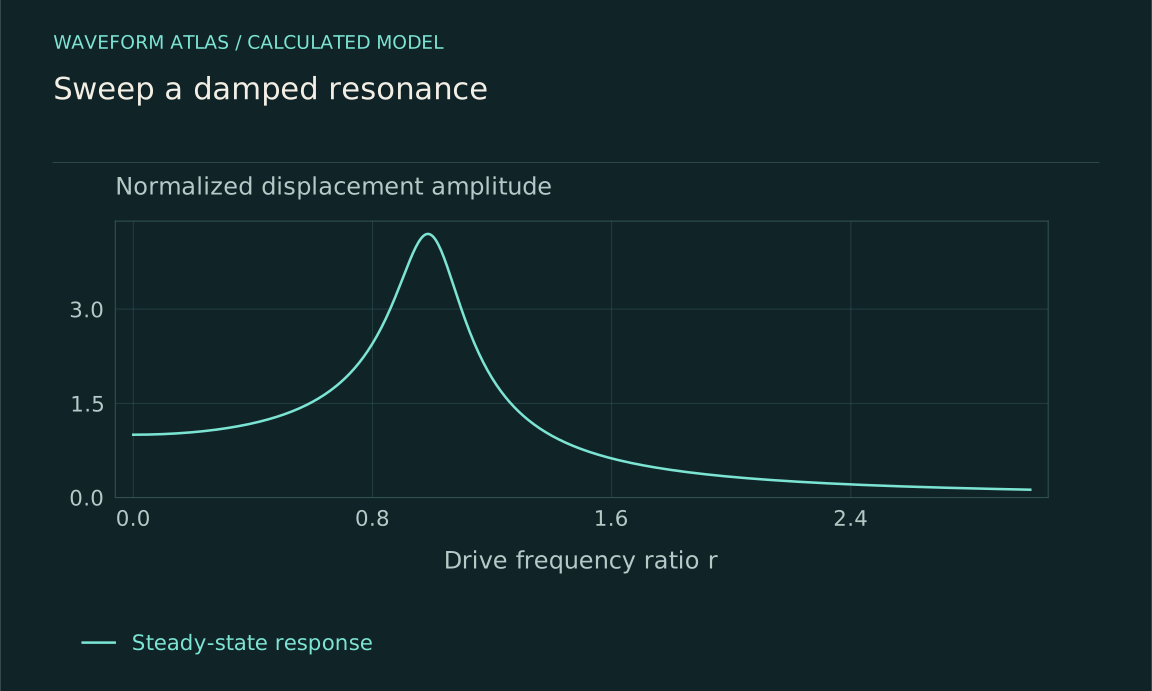
Calculated model curves. Steady-state linear oscillator with drive ratio r = ω/ω₀ and damping ratio ζ. Amplitude is normalized to the static displacement F₀/k. The finite-damping displacement peak need not occur at ω₀. Default control values are used in this fixed figure.
Download SVG ↓Resonance
Why some frequencies produce a stronger response
What makes a response resonant?
The basic resonance model
How do drive frequency and damping set amplitude and phase?
Narrow resonances and long memory
How are linewidth, stored energy, and ringdown related in a specified regime?
When one resonance becomes several
How does coupling split or hybridize normal modes?
Resonant driving of a quantum transition
How does matching a transition frequency change population dynamics?
Driving a parameter instead of applying a direct force
How does modulation excite or suppress particular motion?
Resonance when the frequency depends on amplitude
How do nonlinearity and hysteresis alter a frequency sweep?
A strong response is not automatically synchronization
What distinguishes a resonant passive system from an entrained oscillator?
Identify a resonance without confusing it with the source spectrum
What calibrations and phase measurements establish the system response?
Use resonance while controlling losses and instability
Which design choices balance sensitivity, bandwidth, and settling time?