Penrose’s proposed lifetime
Adjust the controls, inspect the calculated response and use the reading links to place the model in its physical context.
Interactive model: Penrose’s proposed lifetime. Enable JavaScript to adjust its controls.
τ ≈ ℏ / E_G
Hypothesis explorer. E_G is an entered gravitational self-energy of a mass-density difference. This is not a complete collapse model or a verified universal law.
What this model assumes
Hypothesis explorer. E_G is an entered gravitational self-energy of a mass-density difference. This is not a complete collapse model or a verified universal law.
How to explore it
Begin with the default values. Change one control at a time and watch both the graph and the readouts. Then reset the model and change another parameter. This isolates which input produces the effect you are seeing.
The plotted values are generated from the displayed equation. Downloading the calculated data lets you inspect the numerical series or compare it with a calculation of your own. The data are synthetic model outputs, not observations from an apparatus.
Before carrying a prediction into an experiment, match the model’s assumptions to the actual system: the relevant degrees of freedom, boundary conditions, noise, losses and measurement convention. The linked articles explain which comparison is physically meaningful.
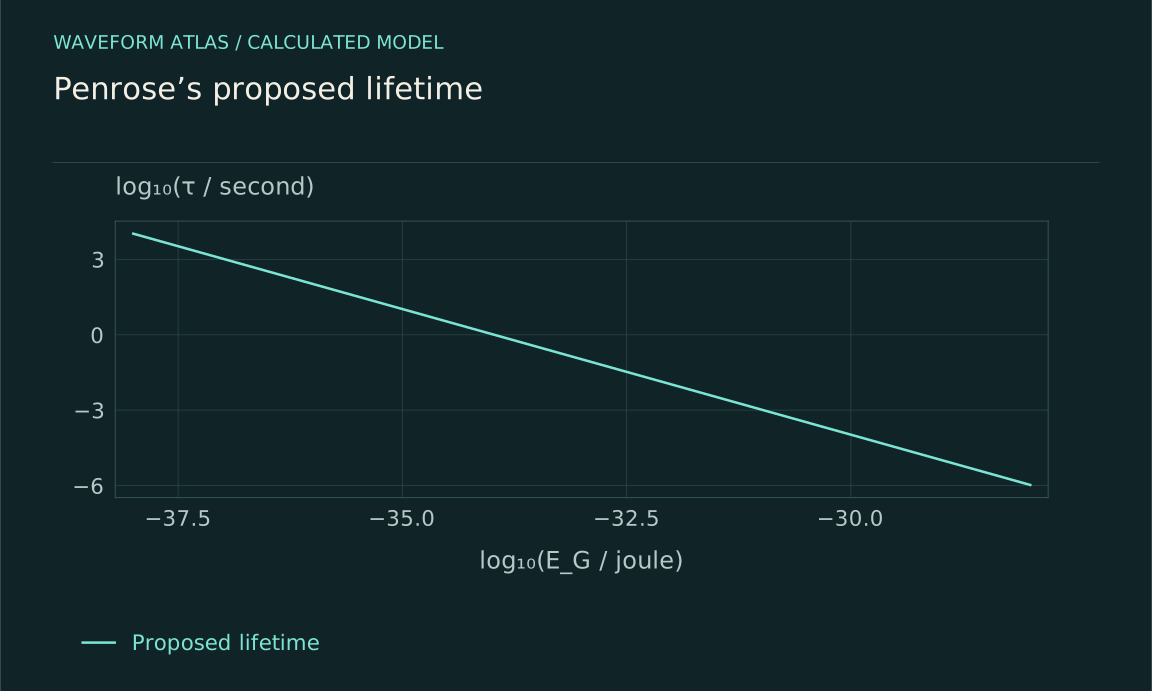
Calculated model curves. Hypothesis explorer. E_G is an entered gravitational self-energy of a mass-density difference. This is not a complete collapse model or a verified universal law. Default control values are used in this fixed figure.
Download SVG ↓Penrose and gravitational objective reduction
Does gravity collapse the wavefunction?
What is Penrose proposing, and what remains unproved?
What Penrose said: papers, lectures, and context
Which primary sources support the opening account of his position?
The unresolved step between a wavefunction and an outcome
What problem is objective reduction intended to solve?
One mass, two possible locations, two geometries
Why does a mass superposition raise a spacetime question?
The energy difference in Penrose’s collapse estimate
What does gravitational self-energy of a density difference mean?
Reading the proposed lifetime tau approximately hbar over EG
What does the proposed collapse-time estimate predict and omit?
Shared timescale, different theoretical constructions
Why are Diósi’s model and Penrose’s argument often grouped together?
What collapse experiments constrain
Which versions have been constrained, and what would count as a stronger test?
From objective reduction to Orch OR: an additional hypothesis
What extra claims are required to connect reduction to consciousness?
Designing a discriminating test of gravity-related collapse
How could an experiment distinguish proposed collapse from ordinary decoherence?