Watch a vibration lose mechanical energy
Adjust the controls, inspect the calculated response and use the reading links to place the model in its physical context.
Interactive model: Watch a vibration lose mechanical energy. Enable JavaScript to adjust its controls.
ẍ + 2βẋ + x = 0
Underdamped viscous oscillator: m = k = 1, x(0) = 1, v(0) = 0. Energy is calculated from displacement and velocity; it is transferred to the omitted environment.
What this model assumes
Underdamped viscous oscillator: m = k = 1, x(0) = 1, v(0) = 0. Energy is calculated from displacement and velocity; it is transferred to the omitted environment.
How to explore it
Begin with the default values. Change one control at a time and watch both the graph and the readouts. Then reset the model and change another parameter. This isolates which input produces the effect you are seeing.
The plotted values are generated from the displayed equation. Downloading the calculated data lets you inspect the numerical series or compare it with a calculation of your own. The data are synthetic model outputs, not observations from an apparatus.
Before carrying a prediction into an experiment, match the model’s assumptions to the actual system: the relevant degrees of freedom, boundary conditions, noise, losses and measurement convention. The linked articles explain which comparison is physically meaningful.
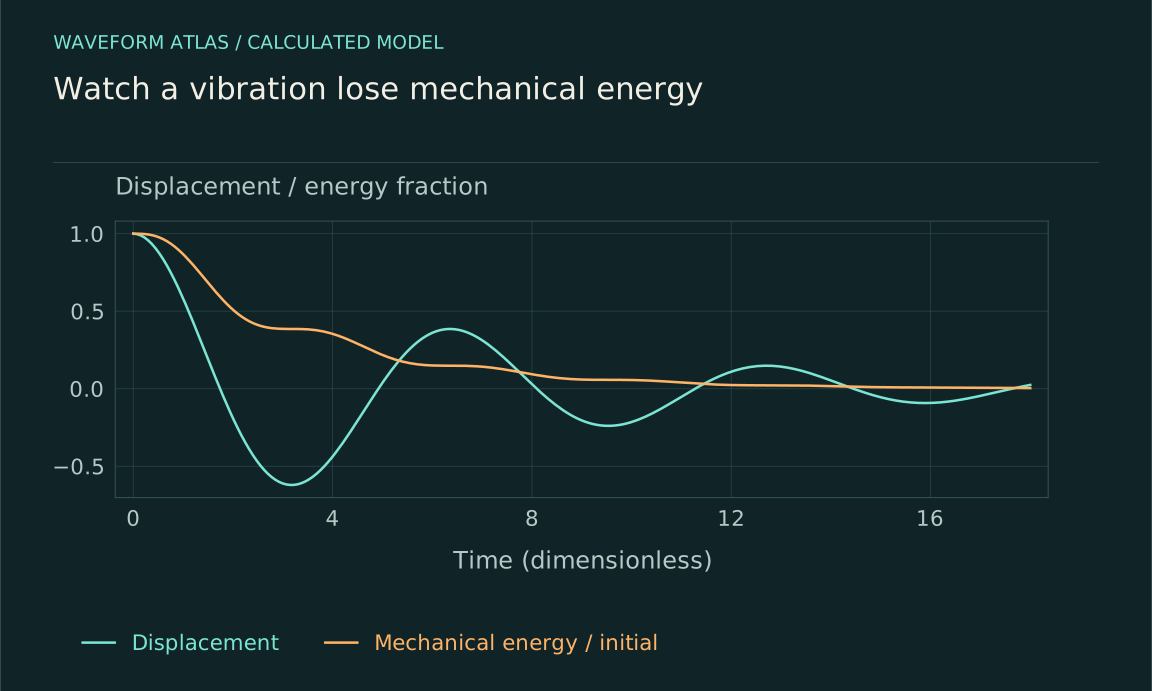
Calculated model curves. Underdamped viscous oscillator: m = k = 1, x(0) = 1, v(0) = 0. Energy is calculated from displacement and velocity; it is transferred to the omitted environment. Default control values are used in this fixed figure.
Download SVG ↓Absorption and damping
How a wave loses energy to its surroundings
What distinguishes absorption, damping, leakage, and redistribution?
The mathematics of a fading oscillation
How do damping strength and natural frequency determine the time trace?
Measuring attenuation through a material
What does an absorption coefficient tell us, and what can it hide?
Viscosity, friction, and internal mechanical loss
How does organized motion become microscopic motion?
How a material absorbs electromagnetic radiation
How do conductivity and material resonances receive wave energy?
What happens when a photon is absorbed?
Which system carries the excitation after a detector or atom absorbs a photon?
Energy loss and coherence loss are not the same observable
Can a system lose phase information without comparable energy loss?
Why a lossy environment also fluctuates
How are damping and environmental noise connected?
Designing a useful absorber
How do impedance matching, thickness, and bandwidth influence absorption?
Close the energy budget in a damping experiment
Which measurements separate heat, scattered power, and stored energy?