Follow the excitation through three stages
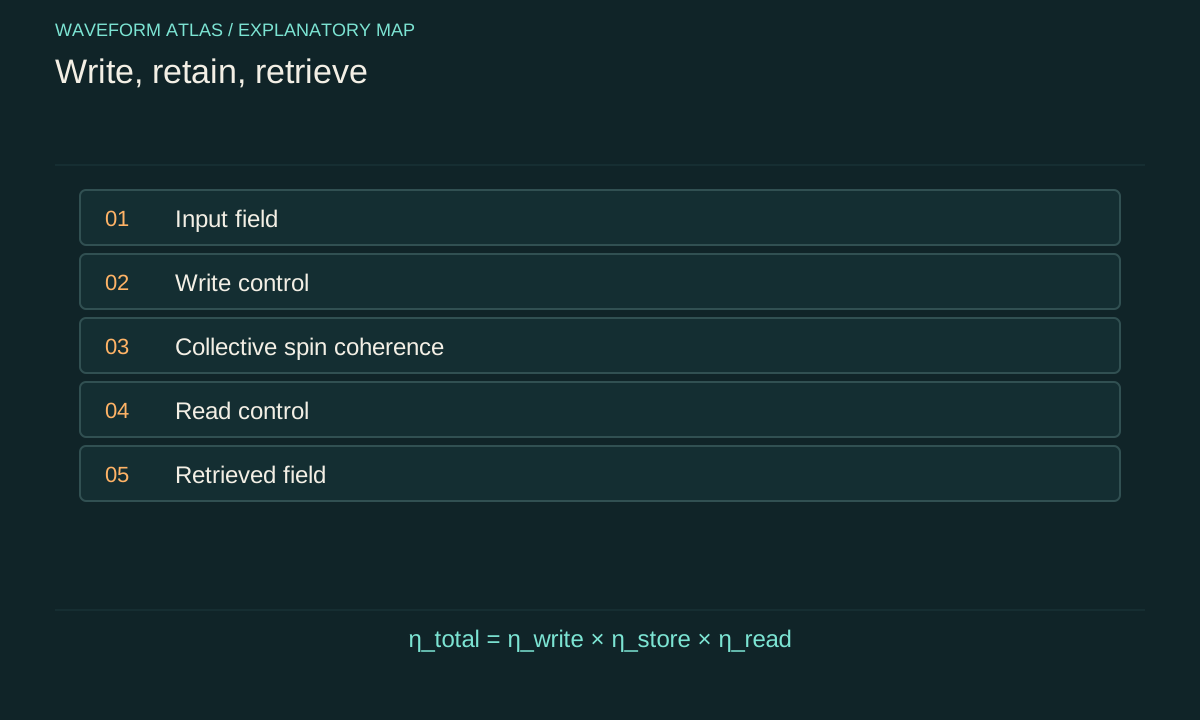
An optical memory has a write stage, a storage interval and a read stage. During writing, an incoming optical field interacts with a prepared medium under suitable control. During storage, the information relevant to later retrieval resides primarily in a material degree of freedom. During reading, a controlled interaction converts that excitation into an outgoing optical field. Describing all three stages is more informative than saying that light stopped.
The stored object is not necessarily an identifiable original photon waiting at a fixed coordinate. Depending on the protocol, it can be a collective coherence distributed among many atoms. The mapping can preserve the amplitude and phase information of a field mode within a finite bandwidth and efficiency. Those qualifications matter because storage is a physical channel with loss, noise and limited capacity, rather than a universal pause button for every possible optical state.
Slow propagation is not yet storage
A pulse can travel slowly through a dispersive medium because its envelope evolves with a small group velocity in a particular frequency range. The field and material response then form a coupled excitation. A small envelope speed does not imply that the microscopic electromagnetic carrier behaves like a miniature rigid object moving slowly between atoms. The distinction between phase velocity, group velocity and energy transport remains essential.
Slow propagation also does not automatically create a memory. A delay line can hold a pulse in transit without offering a controllable storage interval. To demonstrate a memory, one needs a write operation, a period during which the excitation is retained, and a read operation that retrieves the relevant information. A medium that merely delays and distorts a pulse should be evaluated as a propagation channel unless the additional storage behavior is established.
Atomic coherence can carry the information
In a simplified three-level picture, two long-lived lower states and an optically excited state are coupled by a signal field and a control field. Under appropriate preparation and timing, the optical excitation can be mapped into coherence between the lower states. The collective phase includes the spatial phase difference associated with the optical fields. That phase pattern influences the direction and mode of later retrieval.
This description is deliberately schematic. Real atomic memories involve selection rules, optical depth, detuning, motion, collisions and imperfect control. It should not be read as a complete experimental recipe or a claim that every three-level medium provides useful storage. Its purpose is to identify the variable that persists during the nominally dark interval: a material coherence with a phase relation capable of influencing the retrieved field.
The original storage result has a defined scope
Phillips and colleagues reported storage of light in atomic vapor through a controlled mapping involving collective spin coherence. The verified publication record supports the central write–store–read interpretation. It does not justify attaching arbitrary storage times, efficiencies or fidelities to other apparatus. Those quantities depend on the specific implementation and must be measured independently.
The broad lesson survives without importing unverified numerical performance. The outgoing pulse can depend on a coherent material excitation prepared by the incoming pulse, and a control field can determine when that information is converted back into light. This is a striking example of changing the physical carrier of information. It is distinct from cooling the entire medium to a motionless condition and distinct from causing an optical wavefunction to collapse by observing it.
Retrieval efficiency is one metric
Define an energy retrieval efficiency as the retrieved signal energy in a specified output mode divided by the incident signal energy in a specified input mode. The definition must state whether coupling losses before and after the memory are included. A device efficiency and an end-to-end system efficiency can differ substantially while both are reported honestly. The integration window and spectral filter also affect what is counted.
As an illustrative bookkeeping example, suppose a write stage transfers seventy percent of the selected input energy into the memory channel, storage preserves eighty percent of that excitation, and readout converts sixty percent into the collected output mode. The product is 0.336, or 33.6 percent. These are invented model inputs for arithmetic, not experimental performance claims. The remaining energy needs a physical account, such as unabsorbed light, scattering, dissipation or uncollected output.
Phase preservation requires a phase-sensitive test
A retrieved intensity envelope can resemble the input while its phase is randomized. That may suffice for some classical detection tasks but not for every coherent communication or quantum-information task. Interference with a stable reference, or another suitable phase-sensitive measurement, can test whether a reproducible phase relation survives. The reference itself must remain stable over the storage interval.
For a pulse with several temporal or spectral components, preserving one average phase is not enough. Relative phases across the occupied modes determine pulse shape and information content. A memory may distort those phases even when it returns substantial energy. Comparing the complex input and output mode, within the capabilities of the measurement, distinguishes efficient but distorted retrieval from faithful transmission of the chosen field degree of freedom.
Noise changes the meaning of a delayed signal
The control field and medium can generate light that is not a retrieved signal. Detector dark counts, fluorescence, scattering and other processes can produce a pulse-like background near the readout time. Measure a control-only sequence with no input signal, and a signal sequence with the memory interaction disabled or altered. These comparisons establish how much of the output is attributable to stored input information.
At low signal levels, even a small background can dominate the apparent retrieval. A large ratio of output energy to input energy may then indicate amplification or added light rather than unusually good storage. A quantum-memory claim requires tests appropriate to the states and information task in question. Classical pulse retrieval alone does not establish preservation of arbitrary quantum states, just as a recognizable photocopy does not establish that every property of the original object was preserved.
Storage time reveals the material dynamics
During the dark interval, atomic motion, magnetic-field variations, collisions or other interactions can reduce the collective coherence. A simple model might give an amplitude factor exp(−t/T₂), in which case a coherent intensity contribution scales as exp(−2t/T₂). Some papers instead define a lifetime directly from efficiency. The convention must be stated before comparing numbers.
If the amplitude coherence time is one arbitrary unit, waiting one half unit leaves an amplitude factor about 0.607 and an associated intensity factor about 0.368. These are original exponential-model calculations. Actual memory decay can be nonexponential, and readout efficiency may have additional time dependence. Measuring several storage intervals and reporting the fitted quantity prevents a factor-of-two ambiguity between field decay and intensity decay.
Spatial phase connects storage to retrieval direction
The collective excitation can carry a spatial phase pattern set by the writing fields. A read field with a different direction or phase can therefore change the mode into which light is retrieved. The output direction is not merely an arbitrary trajectory of a trapped photon; it follows phase matching and the medium's response. Motion that scrambles the stored spatial phase can reduce retrieval into the desired mode even if local atomic populations remain.
This is one reason population measurements alone do not fully characterize a coherent memory. An ensemble may still contain excited atoms while losing the collective phase relation required for directional emission. Conversely, a weak output in one direction may reflect a changed retrieval mode rather than complete loss of excitation. Angular collection and phase-sensitive characterization complement an energy measurement.
Specify the operational claim
A useful storage report states the input mode, write and read controls, storage interval, collected output mode, efficiency, noise and phase or state fidelity appropriate to the task. It distinguishes an adjustable memory interval from a fixed propagation delay. It also identifies the material degree of freedom that stores the relevant information and the interactions that limit its lifetime.
With those definitions, stopped light becomes a compact historical phrase for a well-specified physical process. The accurate mechanism is a controlled conversion between a propagating optical excitation and a material excitation. The medium continues to have dynamics during storage, and the read operation matters. What has been retained is demonstrated by the correlations between input and retrieved output, not by the absence of a visible beam during the waiting period.
Delay is a useful control experiment
Compare the proposed memory with an ordinary passive delay path adjusted to produce a similar arrival time. The delay path tests what can be explained by propagation and filtering alone. A controllable memory should respond to the write and read schedule in a way that the fixed path does not. Varying the storage interval while preserving the selected input mode supplies a direct operational distinction.
The comparison also reveals a bandwidth tradeoff. A device may delay a narrowband pulse with little distortion while strongly reshaping a shorter, broader pulse. Report the accepted temporal and spectral mode rather than assigning a single storage quality to every input. If the readout time is controllable only within a finite window, that window is part of the demonstrated capability.
What to take forward
- Optical storage changes the carrier of the excitation.
- Efficiency, phase preservation and added noise answer different questions.
- A delayed intensity pulse alone does not certify a general quantum memory.
Go to the original work.
These links identify the sources behind specific claims. Verification scope varies by source and is stated below.
- 1 / Primary experimentPhillips et al., Storage of Light in Atomic Vapor ↗
Reversible mapping of an optical excitation into collective atomic spin coherence.
Verification scope: Publisher abstract and publication record inspected; retrieval is described within that experiment’s scope.
- 2 / University teachingMIT Physics III, Lecture 13: Dispersive Medium, Phase Velocity, Group Velocity ↗
Distinction between phase, group and dispersive pulse propagation.
Verification scope: MIT lecture page and topic description inspected; no experimental speed is imported.
- 3 / University teachingMIT Physics III: Vibrations and Waves ↗
Wave equations, interfaces, optics and propagation in media.
Verification scope: MIT course outline inspected; article derivations are independent textbook-level explanations.
Found a problem with a claim or calculation? Send the page, the claim and the evidence. Read how these articles were prepared.